
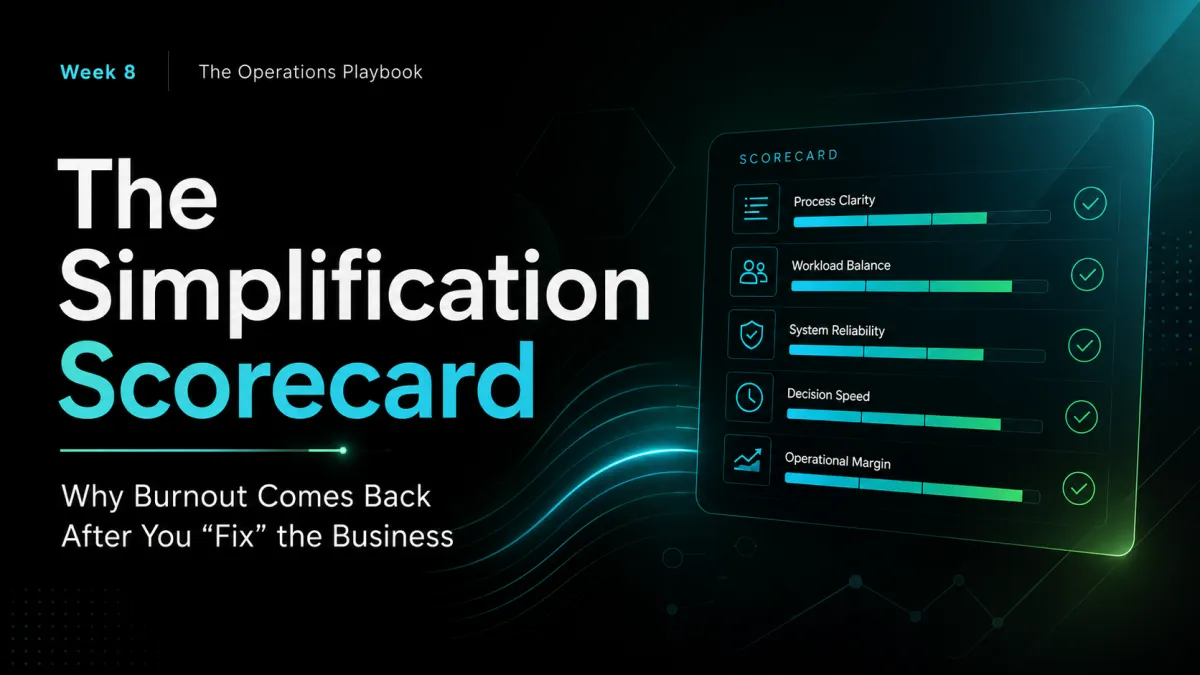
Week 8 - The Simplification Scorecard: Why Burnout Comes Back After You “Fix” the Business
Episode 8: Listen to This Article
Week 7 was about killing process bloat.
Removing documentation no one uses. Cutting steps that exist only because “that’s how we’ve always done it.” Building clarity your team can actually follow.
For most founders, that creates immediate relief.
Fewer questions. Cleaner handoffs. Less friction in the day.
But here’s the part most people don’t expect:
Burnout doesn’t disappear forever. It pauses.
And then, slowly, it comes back.
Not because the business got worse. But because complexity has a way of quietly re-entering when no one is watching.
A few exceptions slip in.
A few “just this once” decisions bypass the process.
A few new edge cases live only in your head again.
And before you realize it, you’re back in familiar territory:
Answering questions you thought were solved. Making decisions you thought were delegated. Protecting clarity instead of benefiting from it.
That’s not a failure of simplification.
It’s the absence of a control system.
Why Simplification Alone Doesn’t Hold
Most founders treat simplification like a cleanup project.
You do it once. You feel better. You move on.
But simplification isn’t a one-time win.
It’s a condition that must be protected.
Because businesses don’t drift toward simplicity. They drift toward complexity.
New clients add nuance. New hires create variation. New tools introduce overlap. Urgency rewards shortcuts.
And none of that feels dangerous in the moment.
That’s why burnout comes back quietly.
Not as chaos — as creep.
Burnout Isn’t Caused by Complexity
It’s Caused by Unmonitored Complexity
Here’s the reframe that matters:
Burnout doesn’t happen because your business is complex. It happens because complexity is allowed to grow without feedback.
When no one is measuring where the business is pulling you back in, you become the early-warning system.
And being the early-warning system is exhausting.
This is where the Simplification Scorecard comes in.
What the Simplification Scorecard Actually Does
The Simplification Scorecard isn’t about KPIs. It’s not about productivity. It’s not about performance.
It’s a weekly lens that answers one question:
Is the business becoming more independent — or more dependent on me?
That’s it.
It’s not designed for the team. It’s designed for the founder.
The Five Signals That Predict Burnout Early
You don’t need twenty metrics. You need a handful of signals that expose complexity while it’s still small.
Each week, ask yourself:
Founder-Dependent Decisions What decisions landed on my desk that should not require me?
Repeated Questions What questions did I answer more than once?
Undocumented Exceptions Where did someone say, “This isn’t in the process”?
Process Bypasses Where was the system skipped to “move faster”?
Clarity Breakdowns Where did work stall because someone didn’t know what to do next?
None of these mean something is “wrong.”
They mean something is forming.
And what you catch early doesn’t turn into burnout later.
Why This Changes How the Business Feels
Without a scorecard, founders experience complexity emotionally.
“I feel pulled back in.”
“I feel more tired again.”
“I feel like I’m carrying too much.”
With a scorecard, complexity becomes visible.
You can point to it. Name it. Decide how to eliminate it.
That shift alone reduces pressure.
Because you stop internalizing the load.
The Only Move You Need to Make This Week
Don’t overbuild this.
Open a doc or spreadsheet.
Create five rows — one for each signal above.
At the end of the week, rate each from 1–5.
Anything below a 4 gets one follow-up question:
What system would prevent this next time?
Not “Who messed up?” Not “Why didn’t this work?”
Just: What system is missing?
That’s how simplification becomes durable.
This Is the Difference Between Relief and Freedom
Simplification creates relief.
The Simplification Scorecard creates stability.
Relief feels good. Stability changes your life.
Because once simplicity is protected by a system, you stop being the guardian of the business.
And that’s when leadership stops feeling like constant vigilance.

Question Starters (Use These Honestly)
Where did you step back into the business this week without realizing it?
What are you still protecting personally that should be protected by process?
If simplicity isn’t being measured, where is complexity quietly returning?
Next Week
This week was about protecting simplification.
Next week, we confront the bigger truth most founders run into next:
Why businesses reliably break at $1M, $5M, and $10M — even when they’re “well run.”
Because simplification is necessary.
But it isn’t enough to break growth ceilings.
That’s where things get interesting.
#FounderBurnout #BuiltNotBought #OperatorLife #SystemsOverHustle #ScaleWithoutBurnout #FounderLed



Mail
Facebook
LinkedIn
X
Pinterest
Reddit