
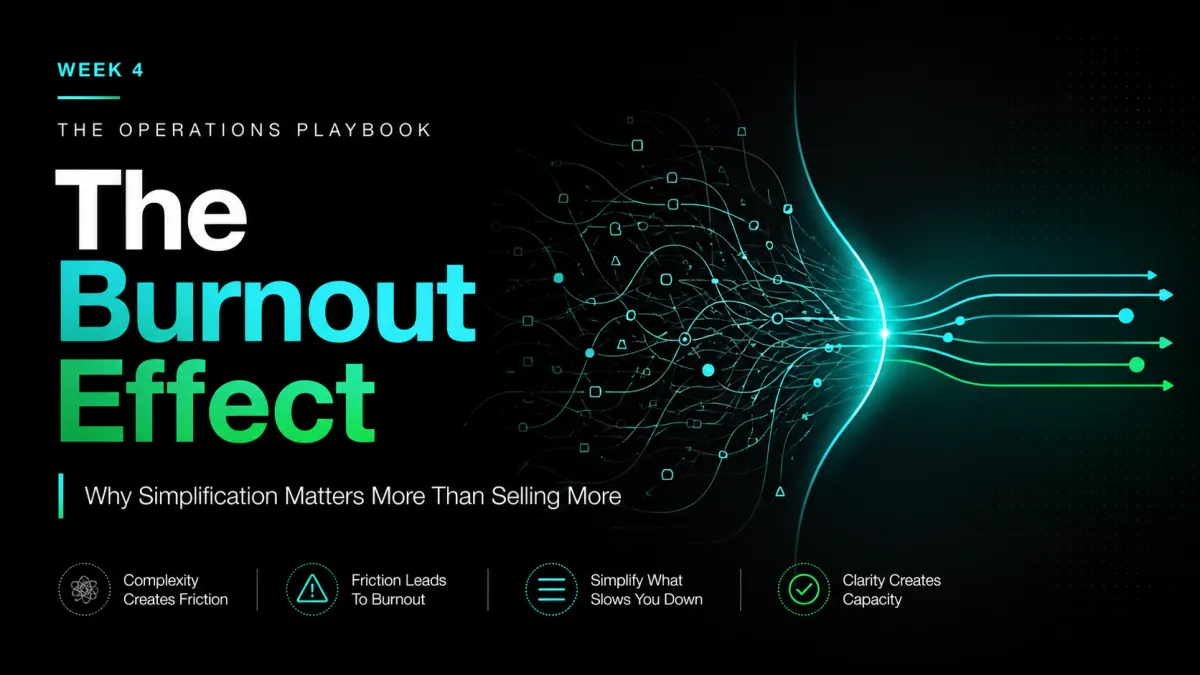
Week 4 - The Burnout Effect: Why Simplification Matters More Than Selling More
Episode 4: Listen to This Article
Most service business owners don’t burn out because they’re lazy or “bad at time management.”
They burn out because the business becomes something they have to carry in their head.
It starts small.
A few client exceptions. A few “quick” internal fixes. A few extra tools to keep things moving. A few meetings to get everyone aligned.
Then one day you realize:
You’re always behind, even when you’re working nonstop
You’re constantly answering the same questions
Your calendar is full, but the work still stacks up
Growth feels like pressure, not progress
And you start thinking the same thought most founders think:
“If we could just sell more… we’d finally have breathing room.”
But selling more doesn’t fix burnout.
If your operations are already heavy, more volume usually adds more stress.
That’s the trap.
The real problem isn’t effort. It’s operational drag.
Burnout isn’t only caused by too much work.
It’s caused by friction inside the work.
Complexity taxes:
Your team’s time (searching, waiting, asking, redoing)
Your delivery capacity (too many handoffs, too many steps)
Your consistency (every client becomes a new version of the process)
Your leadership bandwidth (you become the routing system)
And because complexity creeps in slowly, you don’t notice it right away.
You just feel it.
You feel it when the same project takes longer than it should. You feel it when you dread opening your inbox. You feel it when your team can’t move without you. You feel it when “success” starts costing you sleep.
Here’s the hard truth:
A lot of founders don’t have a motivation problem. They have a complexity problem that shows up as burnout.
Why simplification is the fastest burnout solution
When you simplify your business, something changes immediately:
decisions get easier
work gets cleaner
your team stops depending on you for every answer
delivery stops feeling like a fire drill
And yes, profit improves too.
But the first win you’ll notice is not the margin.
It’s relief.
Because simplification removes the things that create burnout:
rework
ambiguity
constant context switching
“special cases” that break the system
meetings that exist because nothing is clear
Burnout is often a signal that the business is asking your brain to do what the system should be doing.
The Burnout-to-Profit shift most leaders miss
We’ve been taught that more revenue creates stability.
Sometimes it does.
But if the business is already complex, more revenue often creates:
more breakdowns
more questions
more “we need to talk about this” meetings
more work that only you can solve
So you grow… and feel worse.
That’s why simplification is such a powerful lever:
Revenue helps you grow. Simplification helps you breathe. And breathing is what makes growth sustainable.
AI won’t fix burnout if your system is messy
AI amplifies whatever you give it.
A messy process becomes a faster messy process.
A broken workflow becomes an automated broken workflow.
A lack of clarity becomes compounding confusion.
So if you’re already burned out, “adding AI” without simplifying first can actually increase the pressure.
But when you simplify first?
AI becomes a real relief tool.
Automation becomes clean
Decisions become faster
Output becomes predictable
You stop carrying everything in your head
Simplify, then automate. That’s how AI becomes a multiplier instead of a stressor.
Simplification is the new growth strategy (because it prevents burnout)
For years, growth meant adding:
more people
more tools
more offers
more channels
more activity
But the businesses that scale without burning out are doing something different.
They remove.
They strip away everything that doesn’t create value.
They understand this:
You don’t scale by doing more. You scale by doing less, better.
And when you embrace that, profit stops feeling random.
Not because you worked harder.
Because the business stopped fighting itself.
Question starters (use these to find the real bottleneck)
Where does burnout show up first for you: decision-making, delivery, or team dependence?
What part of your business requires the most “mental carrying” right now?
What’s one thing you keep doing that you would not rebuild from scratch today?
Cliffhanger → Next Week
This week was about burnout and the system underneath it.
Next week, we get sharper:
If you could only protect the Core 20% of your business… what would it be?
Because once you know the Core 20%, simplification stops feeling like guesswork.
It becomes a strategy.
#FounderBurnout #OperationalExcellence #BusinessSystems #ServiceBusiness #ProcessImprovement #LeadershipDevelopment



Mail
Facebook
LinkedIn
X
Pinterest
Reddit