
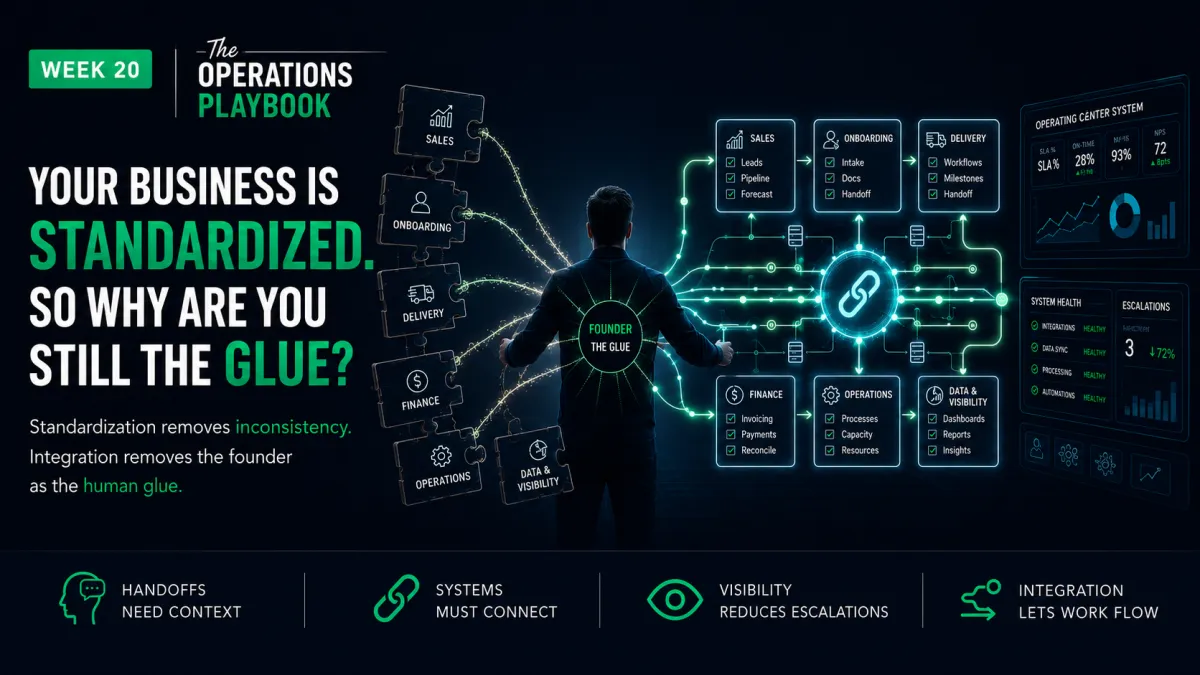
Week 20 - our Business Is Standardized. So Why Are You Still the Glue?
Episode 20: Listen to This Article
You did the work.
You documented the process.
You got your team using the SOPs.
You defined what “done right” looks like.
You standardized the outcome.
And for a while, things started to feel better.
Work became more consistent.
Mistakes dropped.
Training got easier.
People were no longer making up their own version of the process.
That was real progress.
But then something else started showing up.
The process was clear…
…but the handoffs were still messy.
The standard was defined…
…but the tools were still disconnected.
The team knew what to do…
…but someone still had to connect the dots.
And somehow, that someone was still you.
Not because the process was broken.
Not because your team was incapable.
Not because the SOP was missing.
Because the business still depended on you to make the system work together.
That is the next layer of the Execution Gap.
The Cost — Standardized Work Can Still Depend on the Founder
This is the part most founders do not expect.
They think once the process is documented and standardized, the business should run without them.
And sometimes it does.
For a little while.
But then the gaps start showing up between the steps.
A client handoff gets missed.
A project moves forward without the right information.
A task is completed, but the next person does not know it is ready.
A tool gets updated, but nobody tells the team.
A decision is made in Slack, but never makes it back into the process.
So the team comes back to you.
“Do you know where this stands?”
“Who owns this now?”
“Did this get sent?”
“Are we waiting on the client or on us?”
“Should I move this forward?”
And suddenly, you realize something frustrating:
You standardized the work.
But you never integrated the flow.
That means you are still the connection point.
You are still the person translating between people, tools, tasks, and decisions.
You are still the operating layer between the process and the business.
That is exhausting.
Because now you are not doing every task.
But you are still holding the system together.
The Root — Standardization Is Not Integration
This is the next reframe.
Documentation is not execution.
Execution is not consistency.
And consistency is not integration.
Each layer matters.
But they are not the same thing.
Documentation says:
“Here is how the process works.”
Execution says:
“The team is actually using it.”
Standardization says:
“This is what good looks like every time.”
Integration says:
“This process is connected to how work actually moves through the business.”
That last part is where many founder-led businesses break down.
The SOP exists.
The standard exists.
The team understands the work.
But the process still lives separately from the tools, handoffs, ownership, communication, and reporting that make the work move.
So the founder becomes the bridge.
Between sales and fulfillment.
Between project management and client communication.
Between the CRM and the operations team.
Between what was promised and what needs to happen.
Between the task and the outcome.
And when the founder is the bridge, the business is not integrated.
It is dependent.
The Shift — From Standardized Tasks to Connected Workflows
Standardization helps people do the work correctly.
Integration helps the work move correctly.
That is the shift.
From:
“We have a process.”
To:
“The process moves through the business without me.”
From:
“Everyone knows what good looks like.”
To:
“Everyone knows what happens next.”
From:
“The SOP is documented.”
To:
“The workflow is connected.”
This is where operational maturity starts to feel different.
Because now the business is not just producing consistent work.
It is moving work through the company with less friction.
Less chasing.
Less checking.
Less founder intervention.
Less “Where does this stand?”
Less “Who owns this?”
Less “Did this happen yet?”
The founder stops being the traffic controller.
The system starts showing the team where to go next.
What This Actually Looks Like
Before integration:
A client signs.
Sales knows.
Operations sort of knows.
Someone creates a task.
Someone else asks where the intake form is.
The project manager checks Slack.
The founder confirms what was promised.
The team starts the work.
But the handoff depended on memory.
After integration:
A client signs.
The CRM updates.
The onboarding task is created.
The owner is assigned.
The intake checklist appears.
The client communication is triggered.
The team knows what happens next.
The founder does not have to translate the handoff.
That is the difference.
In one version, the business depends on human follow-up.
In the other, the workflow carries the process forward.
Where Most Teams Break Down
Most integration problems show up in the spaces between people.
The process may be clear inside one role.
But the handoff between roles is unclear.
The SOP may explain what one person does.
But not what happens before or after.
The project board may show tasks.
But not whether the process is healthy.
The CRM may hold customer data.
But not the operational context the team needs.
The reporting may show results.
But not where work is getting stuck.
That is why founders keep getting pulled back in.
They are not always answering process questions.
They are answering connection questions.
Who owns this?
What happens next?
Where does this go?
What did we promise?
Has this been completed?
Is this ready for the next step?
Those questions are not signs of a bad team.
They are signs of an unintegrated system.
This Is Where PlaybookOps Evolves Again
PlaybookOps is not just about creating documentation.
It is about turning founder knowledge into a business operating system.
That means the playbook cannot sit off to the side.
It has to connect to the way work actually happens.
The process.
The owner.
The tool.
The handoff.
The standard.
The status.
The visibility.
The feedback loop.
Because a playbook that is separate from execution eventually becomes another document.
But a playbook connected to execution becomes infrastructure.
That is the real move.
From stored knowledge to operational flow.
From SOPs to systems.
From founder memory to business intelligence.
The Path — What Changes When Integration Clicks
When integration is working, several things change.
Handoffs Get Cleaner
People know what information needs to move, who owns the next step, and when the work is ready.
Tools Start Supporting the Process
The CRM, project management system, communication channels, and documentation stop operating like separate islands.
Accountability Gets Easier
Ownership is visible. Status is visible. Delays are visible.
The Founder Stops Being the Connector
You no longer have to remember every promise, clarify every handoff, or chase every loose end.
Scale Becomes Lighter
Not because there is less work.
Because the work moves through the business with less friction.
That is what integration creates.
It removes the hidden drag.
The First Move — What To Do Today
Do not try to integrate the whole business this week.
Start with one handoff.
Pick the place where work most often gets stuck between two people, two departments, or two tools.
Then ask:
What triggers this handoff?
Who owns the next step?
What information must transfer?
Where does the team check status?
What does “ready for the next step” mean?
What usually forces the founder to get involved?
That last question matters most.
Because wherever the founder has to connect the dots, the system is not fully integrated yet.
Fix that one handoff.
Then move to the next.
The Strategic Takeaway — Integration Is What Removes the Founder From the Middle
Most founders think the goal is to document the business.
That is only the beginning.
Then the team has to execute.
Then the work has to become consistent.
Then the workflows have to connect.
Because until the system is integrated, the founder is still the glue.
And glue does not scale.
Systems do.
The real progression looks like this:
Founder Knowledge → Documented Systems → Team Execution → Standardized Outcomes → Integrated Workflows → Operational Intelligence → AI-Enabled Leverage
Each layer reduces dependency.
Each layer removes more of the founder from the middle.
And each layer makes the business more capable of running without constant founder intervention.
The Question
Where does your business still depend on you to connect the dots?
Between people.
Between tools.
Between handoffs.
Between decisions.
Between what was promised and what actually happens.
That is where your next system needs to be built.



Mail
Facebook
LinkedIn
X
Pinterest
Reddit