
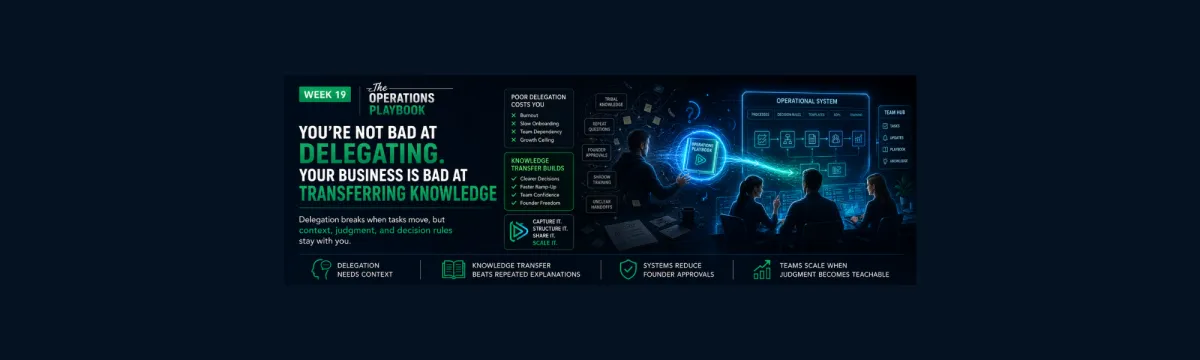
Week 19 - The Execution Gap: Why Every System Still Leads Back to You
Episode 19: Listen to This Article
You did what every business owner is told to do.
You documented the process.
You built the SOPs.
You created the playbooks.
You tried to get your team using them.
You started defining what “done right” looks like.
You even looked at automation.
And for a moment, it probably felt like you were finally building your way out of the middle.
But then something frustrating happened.
The business still found its way back to you.
Your team still asked.
You still approved.
You still corrected.
You still clarified.
You still got pulled into the same conversations you thought the system was supposed to solve.
“Can you take a quick look at this?”
“Is this how you would handle it?”
“Do we still do it this way?”
“What should I do with this exception?”
And suddenly, you’re right back in the middle.
Not because you ignored the problem.
Not because you failed to create systems.
Not because your team is bad.
Because the real problem was bigger than documentation.
It’s called the Execution Gap.
The Execution Gap is the distance between what the founder knows…
…and what the business can consistently execute without them.
And that gap is where burnout happens.
The Cost — Founder Dependency Does Not Disappear Because You Wrote It Down
This is the part most founders do not expect.
They think documentation will solve dependency.
And it helps.
But documentation alone does not remove the founder from the system.
Because the business does not just depend on your steps.
It depends on your judgment.
Your context.
Your standards.
Your decision rules.
Your exceptions.
Your sense of what “right” looks like.
So even when the SOP exists, the team still comes back to you when something feels unclear.
And over time, that creates a hidden operating pattern:
When the process is unclear, ask the founder.
When the standard is fuzzy, ask the founder.
When the customer situation is unusual, ask the founder.
When the handoff breaks, ask the founder.
When the automation does something weird, ask the founder.
That pattern becomes the real system.
Not the SOP.
Not the CRM.
Not the project management board.
You.
And that is expensive.
It costs you time.
It slows down the team.
It creates decision fatigue.
It makes growth heavier than it should be.
And eventually, it lowers the value of the business because too much still depends on one person.
The founder.
The Root — The Execution Gap Is Not One Problem
Over the last few weeks, we’ve been walking through the layers.
Week 15 was about this:
Documentation does not equal execution.
You can have SOPs and still have a team that does not use them during the actual work.
Week 16 was about this:
Execution does not equal consistency.
People can follow the same process and still produce different outcomes if the standard of “done right” is unclear.
Week 17 was about this:
Automation does not solve chaos.
It multiplies whatever already exists.
If the system is clear, automation creates leverage.
If the system is unclear, automation creates confusion faster.
Week 18 is the bigger reframe:
All of these are symptoms of the same deeper issue.
It is the gap between:
What the founder knows What the team understands What the business has documented What the team actually follows What leadership can see And what the system can improve or automate
When that gap is open, the founder stays trapped.
Different problem.
Same bottleneck.
The Shift — From Founder as Operating System to Business as Operating System
Most founder-led businesses are not really run by systems.
They are run by the founder.
The founder is the memory.
The founder is the decision tree.
The founder is the escalation path.
The founder is the quality control system.
The founder is the dashboard.
The founder is the glue.
And for a while, that works.
It may even be the reason the business survived the early years.
But what gets you to one stage becomes the thing that traps you in the next.
At some point, the business has to stop running through the founder and start running through the system.
That is the real shift.
From: “Ask me and I’ll tell you what to do.” To: “The system shows you how to move.”
From: “The founder knows what right looks like.” To: “The standard defines what right looks like.”
From: “I need to check everything.” To: “The system shows me where attention is actually needed.”
From: “AI might help us automate this.” To: “Our operations are clear enough for AI to amplify.”
That is operational maturity.
What This Actually Looks Like
Before:
A team member starts a process.
They hit an unclear step.
They check the SOP.
The SOP explains the basic task, but not the exception.
They hesitate.
They message the founder.
The founder answers.
The work moves forward.
But the system does not improve.
So the same question comes back next week.
After:
A team member starts a process.
They hit an unclear step.
They check the playbook.
The playbook includes the decision rule, the owner, the standard, the exception path, and the definition of done.
They move forward.
If the issue is new, it gets captured and added back into the system.
The founder is not the answer bank.
The system gets smarter.
That is the difference.
In one version, the founder absorbs the gap.
In the other, the system closes it.
Where Most Teams Break Down
The Execution Gap usually shows up in four places.
Knowledge is still trapped in people’s heads. The founder knows the context, but the system only contains the steps.
Documentation exists, but it is not used during execution. The SOP is stored somewhere, but daily work happens somewhere else.
Work is happening, but leadership cannot see it without asking. So the founder becomes the dashboard.
Data exists, but it does not improve the system. The company has reports, but not operational intelligence.
That is why more documentation is not always the answer.
More tools are not always the answer.
More automation is not always the answer.
The answer is closing the right gap in the right order.
This Is Where PlaybookOps Evolves
This is the bigger shift behind PlaybookOps.
It is not just documentation.
Documentation matters.
But documentation is not the destination.
Execution is.
The real goal is not:
“Here is the SOP.”
The real goal is:
“Here is the operating system your team can run from.”
That means capturing the knowledge.
Turning it into usable playbooks.
Connecting those playbooks to execution.
Making the work visible.
Creating feedback loops.
And eventually allowing AI to support, improve, and automate what is already clear.
Because AI cannot automate what your team cannot explain.
And your team cannot execute what the system does not contain.
The Path — How the Execution Gap Closes
The path looks like this:
Founder Knowledge → Documented Systems → Team Execution → Operational Intelligence → AI-Enabled Leverage
Each layer matters.
Founder Knowledge is where the business starts.
Critical information lives in the founder’s head.
Documented Systems are where that knowledge becomes captured.
The process, standards, decisions, tools, owners, and handoffs become visible.
Team Execution is where the system starts changing behavior.
The team uses the playbooks instead of relying on memory or founder approval.
Operational Intelligence is where leadership can finally see what is happening.
Not through constant check-ins.
Through the system.
AI-Enabled Leverage is where AI becomes useful.
Not as a magic fix.
As an amplifier of clear, documented, visible operations.
Skip a layer, and the founder becomes the fallback again.
The First Move — What To Do Today
Don’t try to fix every system this week.
Start with the last five times your team came to you with a question.
Write them down.
Then ask:
Was the answer missing from the system?
Was the SOP unclear?
Was the standard undefined?
Was ownership fuzzy?
Was the team unsure who could decide?
Was the exception path missing?
Was the automation disconnected from reality?
That list will show you where the Execution Gap is still open.
And once you see the gap, you can stop treating every interruption like a one-off.
You can start treating it like system feedback.
The Strategic Takeaway - Burnout Is a Signal
Most founders think burnout means they need to work harder, hire faster, or buy better tools.
Sometimes that’s true.
But often, burnout is a signal that too much of the business still depends on the founder.
Too much knowledge.
Too much approval.
Too much quality control.
Too much visibility.
Too much judgment.
Too much glue.
You are not broken.
Your team is not broken.
But your execution system may be incomplete.
That is the Execution Gap.
And once you can name it, you can start closing it.
The question is:
Where does your business still route work, decisions, or exceptions back through you?
That is where the next system needs to be built.
#FounderBurnout #BusinessSystems #Operations #ScalingBusiness #ProcessImprovement #OperationalExcellence #AIForBusiness



Mail
Facebook
LinkedIn
X
Pinterest
Reddit