
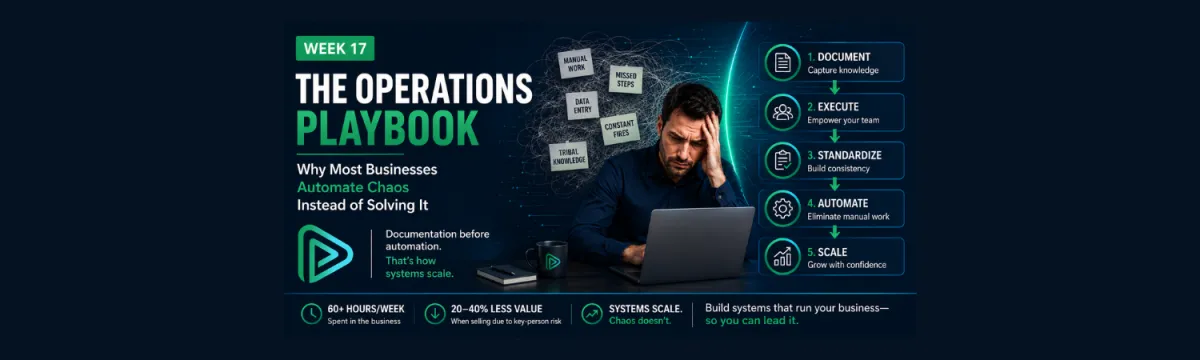
Week 17 - The Feeling - Why Most Businesses Automate Chaos Instead of Solving It
Episode 17: Listen to This Article
You finally hit the point where you know something has to change.
Your team is overloaded.
You’re answering the same questions.
Work keeps slipping through cracks.
And now everywhere you look, people are talking about AI.
Automation. Agents. Workflows.
“Scale without hiring.” So you start looking at tools.
Zapier. Make. AI agents. CRMs. Automated onboarding.
And for the first time in a while, it feels like there might actually be a way out.
But then something strange happens.
You automate a few things.
And somehow… The business feels even messier.
Now instead of manual chaos, you have automated chaos.
Notifications firing everywhere. Broken workflows. Tasks triggering incorrectly. Team members bypassing systems. Customers getting inconsistent communication.
And underneath all of it is the same feeling:
“Why does this still require me to step in?”
Because automation didn’t solve the root problem.
It accelerated it.
The Cost - Speed Multiplies Whatever Already Exists
This is the part most founders miss.
Automation is not a fix for operational dysfunction.
It’s a multiplier.
Which means:
If your systems are clear… automation creates leverage.
If your systems are unclear… automation creates confusion faster.
And the dangerous part is that automation can make broken operations look productive for a while.
Things move faster.
Notifications fire.
Data syncs.
Tasks get assigned.
But underneath it?
The same inconsistencies still exist.
Only now they happen at scale.
This is why so many founders feel disappointed after implementing automation.
Because what they actually needed wasn’t automation.
They needed operational clarity first.
Without that:
Automation creates more exceptions
Teams stop trusting systems
Leaders override workflows manually
Processes drift even faster
And founders become the human glue holding everything together
Again.
Different software.
Same bottleneck.
The Root - Automation Without Documentation Creates Drift
Most businesses try to automate before they standardize.
That’s backwards.
Because automation only works when the process itself is already stable.
Think about it this way:
You can’t automate confusion.
You can only automate decisions that have already been clarified.
And most businesses haven’t clarified them.
The process still lives in conversations.
In Slack messages.
In someone’s memory.
In “the way Sarah usually does it.”
So what happens?
A founder hires an automation consultant.
They build workflows around assumptions.
The workflows break.
The business changes.
Nobody updates the process.
Now the automation is disconnected from reality.
And eventually someone says:
“Just forget the automation. We’ll do it manually.”
Not because automation doesn’t work.
Because undocumented businesses cannot sustain automation.
This is the hidden truth nobody talks about:
Automation is downstream from documentation.
Documentation creates clarity.
Clarity creates consistency.
Consistency creates automatable patterns.
And only then does automation create scale.
The Shift - From Manual Execution to Operational Intelligence
Weeks 15 and 16 were about:
Documentation → Execution → Standardization
Week 17 is the next layer:
Standardization → Automation
But not random automation.
Intentional automation.
The kind that removes friction instead of creating dependency.
This is where businesses begin operating differently.
Because now:
The SOP defines the process
The standard defines the outcome
And automation reinforces both
Instead of employees trying to remember every step…
The system supports execution automatically.
This is where operational maturity starts to compound.
Not because humans disappear.
But because humans stop carrying unnecessary operational weight.
What Healthy Automation Actually Looks Like
Most founders think automation means replacing people.
That’s usually wrong.
Healthy automation removes repetitive friction so people can focus on judgment, relationships, and execution.
Bad automation says:
“Let’s automate everything.”
Healthy automation asks:
“What keeps slowing the team down unnecessarily?”
There’s a difference.
Before:
A new lead comes in → someone manually enters data → someone sends an email → someone creates a task → someone follows up
After:
Lead comes in → system routes data → tasks trigger automatically → follow-up sequence starts → team focuses on conversation, not administration
Notice what changed:
The people didn’t disappear.
The friction did.
That’s what strong operations actually look like.
Not robotic businesses.
Clear businesses.
Where Most Automation Projects Fail
Automation breaks when:
There’s no documented process underneath it
Nobody owns maintaining workflows
The business changes but the automations don’t
The team doesn’t trust the system
Founders automate exceptions instead of standards
And here’s the big one:
Most businesses try to automate complexity they should have simplified first.
That’s why founders end up overwhelmed by their own tech stack.
Five disconnected tools.
Thirty workflows.
Nobody knows what talks to what.
And every new hire needs a 90-minute explanation just to understand the system.
That isn’t scale.
That’s operational debt.
The best operators simplify first.
Then automate.
This Is Where PlaybookOps Evolves Again
This is the layer most businesses never reach.
Because most companies stop at documentation.
Some reach standardization.
Very few connect documentation directly to execution and automation.
That’s the shift.
Not just:
“Here’s the SOP.”
But:
“Here’s the SOP connected to how the business actually runs.”
Because the future isn’t more software.
The future is operational intelligence.
Systems that:
Capture knowledge
Standardize execution
Trigger workflows
Reduce operational friction
And support scale without increasing founder dependency
That’s the real opportunity.
Not replacing humans.
Removing unnecessary operational drag.
The Path - What Changes When Automation Actually Works
When automation is built on documented, standardized systems:
Speed Increases
Without sacrificing quality.
Teams Stop Repeating Administrative Work
And focus on execution instead.
Training Simplifies
Because workflows support the process automatically.
Operations Become More Predictable
Because systems reinforce consistency.
Leadership Gets Time Back
Because they stop manually holding processes together.
And this is the subtle shift founders feel first:
The business stops feeling heavy.
Not easy.
But lighter.
Because the operational burden is no longer sitting entirely on people.
Especially the founder.
The First Move - What To Do Today
Don’t start by automating everything.
Start here:
👉 Pick one repetitive operational task your team handles every single day.
Then ask:
Is the process clearly documented?
Is the outcome standardized?
Does everyone currently do it the same way?
If the answer is no…
Don’t automate it yet.
Fix the process first.
Then automate the friction.
Not the chaos.
The Strategic Takeaway - Automation Is Not the Beginning
Most founders think automation is the first step.
It’s not.
Automation is what happens after operational clarity exists.
The real progression looks like this:
Documentation → Execution → Standardization → Automation → Scale
Miss one layer…
And the next layer becomes unstable.
That’s why businesses with the most software are not always the most scalable.
Because software alone doesn’t create operational maturity.
Systems do.
The companies that win in the AI era will not be the ones with the most tools.
They’ll be the ones with the clearest operational foundation.
Because clear systems scale.
Chaos doesn’t.
The Question
Where in your business are you trying to automate something…
…that still isn’t actually standardized?
That’s probably the operational bottleneck slowing everything else down.
#Operations #BusinessSystems #Automation #Leadership #Scale #AI #ProcessImprovement #PlaybookOps



Mail
Facebook
LinkedIn
X
Pinterest
Reddit