
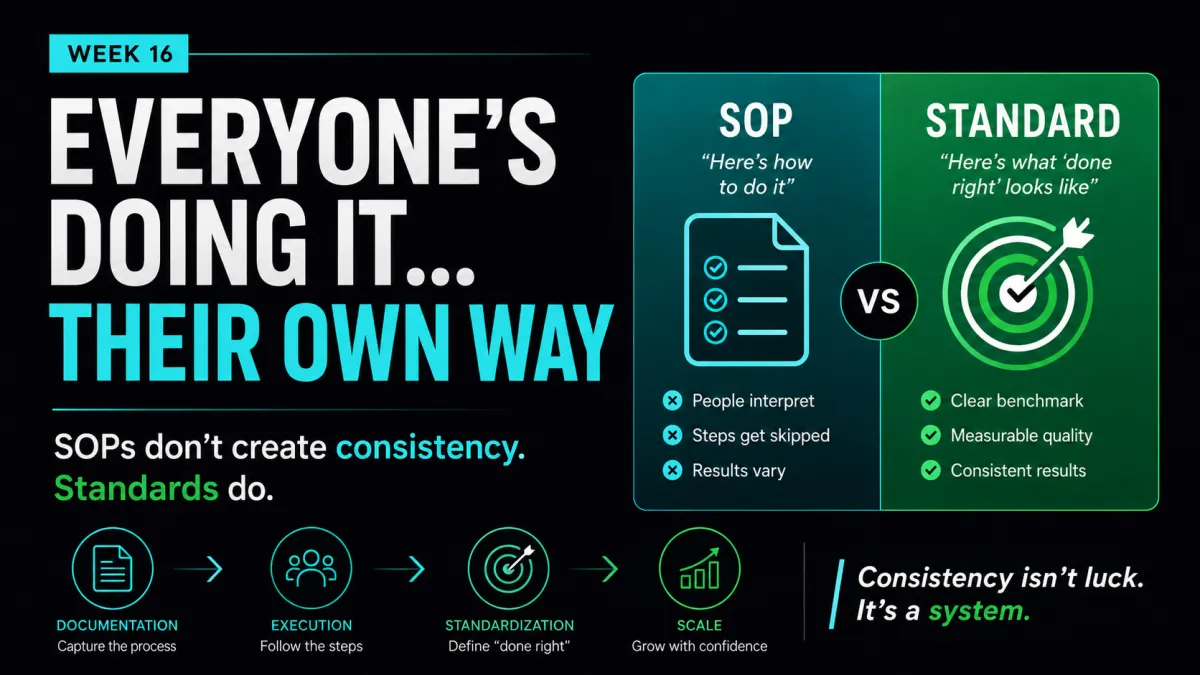
Week 16 - The Feeling - “Everyone’s Doing It… Their Own Way”
Episode 16: Listen to This Article
You fixed the first problem.
You got the processes out of your head.
You documented them. Built SOPs. Created playbooks.
That was supposed to be the hard part.
But now something new is happening…
Same process. Different people. Different results.
One team member does it perfectly. Another cuts corners. Another adds steps that were never there.
And you find yourself thinking:
“Why does this feel different every time?”
Or worse -
“Why do I have to keep correcting the same thing?”
So you step back in.
Not because you want to…
But because consistency isn’t happening on its own.
The Cost - When Inconsistency Becomes Invisible
This is where most businesses quietly stall.
Not because they lack effort.
But because they lack consistency.
And the cost doesn’t show up all at once, it compounds.
Customers get different experiences depending on who they work with
Quality fluctuates (and you feel it before you can measure it)
Your best people carry the weight of your weakest systems
You spend time correcting instead of scaling
And here’s the part most founders don’t realize:
Inconsistent execution kills trust, internally and externally.
Your team starts second-guessing what “right” looks like.
Your customers start feeling the variation.
And your business starts losing the one thing that actually scales:
Reliability.
The Root - SOPs Don’t Create Consistency
This is the next layer most founders miss.
Just like documentation didn’t create execution…
SOPs don’t create consistency.
Because consistency doesn’t come from instructions.
It comes from standardization.
There’s a difference:
SOP = “Here’s how to do it”
Standard = “Here’s what ‘done right’ looks like”
Most teams have the first.
Very few have the second.
So what happens?
Your team reads the SOP…
But then interprets it.
Adjusts it.
Personalizes it.
Not because they’re doing it wrong,
Because there’s no clear definition of what “right” actually is.
And when that’s missing…
Everyone defaults to their own version.
The Shift - From Execution to Standardization
If Week 15 was about moving from information → execution
Week 16 is about moving from:
Execution → Consistency
This is where your system matures.
Because now the question isn’t:
“Are people using the SOP?”
It’s:
“Are they producing the same outcome every time?”
High-performing businesses don’t just execute processes.
They standardize outcomes.
What This Actually Looks Like
Before:
Your team follows the SOP → interprets steps → delivers outcome → results vary
After:
Your team follows the SOP → compares to standard → adjusts → delivers consistent result
The difference?
A defined standard of “done right”
Where Most Teams Break Down
Even after documenting and executing, consistency fails when:
There’s no example of what “good” looks like
QA is subjective instead of defined
Feedback isn’t tied to the SOP
No one owns maintaining the standard
So what happens?
People guess.
And guessing creates variation.
This Is Where PlaybookOps Evolves Again
This is the next layer.
Not documentation. Not just execution.
Standardized execution.
Because now:
SOPs define the process
Standards define the outcome
Systems reinforce both
This is where your business starts to feel different.
Because:
Output becomes predictable
Training becomes faster
Corrections decrease
Confidence increases
And most importantly,
You stop being the quality control system.
The Path - What Changes When Consistency Clicks
When standardization is in place:
Consistency Replaces Variability
Your customers get the same experience, every time.
Quality Becomes Measurable
You know what “good” looks like, and can enforce it.
Training Speeds Up
New hires don’t guess, they replicate.
Leadership Scales
Because you’re not constantly correcting.
And this is where something subtle, but powerful - happens:
Your business becomes dependable.
And dependable businesses scale.
The First Move - What To Do Today
Don’t overhaul everything.
Start here:
👉 Pick one process where results vary the most
Then ask:
What does “done right” actually look like?
Do we have a clear example of it?
Can someone measure whether it was done correctly?
Then fix one thing:
👉 Define and document the standard - not just the steps
The Strategic Takeaway - Consistency Is a System
Most founders think:
“If people just followed the process… we’d be fine.”
But that’s incomplete.
Because even with execution - Without standards, consistency breaks.
And without consistency
Scale breaks.
The real system looks like this:
Documentation → Execution → Standardization → Scale
Miss one…
And the entire system weakens.
The Question
Where in your business are people following the process…
…but still producing different results?
That’s where your next level of growth is hiding.
#Operations #BusinessSystems #Leadership #Scale #ProcessImprovement #playbookops




Mail
Facebook
LinkedIn
X
Pinterest
Reddit