
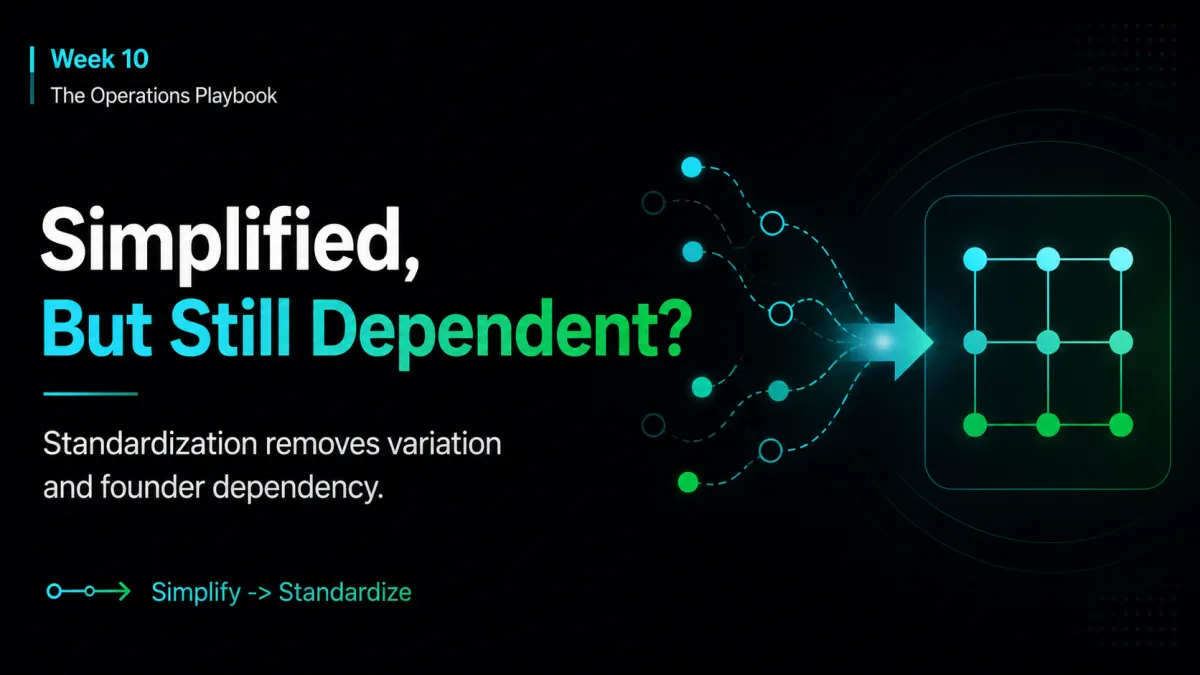
Week 10 - You Simplified the Business. So Why Does It Still Feel Like It Depends on You?
Episode 10: Listen to This Article
You finally did it.
You cut the extra services that weren’t worth the drag. You cleaned up the tool stack. You got clearer about what matters. You stopped saying yes to everything.
The business is simpler now.
And yet… you still can’t step away.
Your team still pings you all day. Work still gets stuck waiting for your approval. Edge cases still land on your desk. You still do your “real work” after hours.
So the question becomes:
If the business is simpler, why am I still exhausted?
Because simplification reduces complexity.
But it doesn’t automatically reduce dependency.
And founder burnout isn’t just created by too much to do.
It’s created by being required for too many things.
Simplification Isn’t the Finish Line. It’s the Setup.
A lot of founders think simplification is the cure.
“If I just cut the noise, I’ll finally breathe.”
And simplification does help. It removes clutter. It creates focus. It reduces the number of moving parts.
But there’s a hidden trap:
You can run a simple business that still collapses the moment you step away.
Because the real issue isn’t the number of moving parts.
It’s the fact that the parts don’t move the same way without you.
That’s why this week matters.
Week 10 isn’t about doing more.
It’s about recognizing you’re standing on a bridge:
Simplify → Standardize
Most founders stall here because the business looks cleaner, but it still feels heavy.
That heaviness has a cause.
The Real Burnout Engine: Variation
Variation is the silent creator of founder dependency.
When the same work is done five different ways depending on who touches it, someone has to reconcile it.
That “someone” is usually you.
Here’s how it shows up:
A customer issue comes in and no one knows what “we normally do,” so they ask you.
A project gets delivered, but quality is inconsistent, so you review everything.
A pricing exception pops up, and there’s no clear rule, so you approve it.
Onboarding happens differently every time, so you get pulled in to “make sure it’s right.”
This is why founders feel trapped even after simplifying.
Because the company still runs on judgment calls — and you’re the primary source of judgment.
Simplification removes excess.
Standardization removes variation.
And removing variation is what reduces dependency.
Standardization Isn’t Bureaucracy. It’s Freedom.
Founders hear “standardization” and think:
“Great. More documents. More red tape. More process for process’ sake.”
But real standardization is the opposite.
Standardization is simply defining “the way we do it here” so your team doesn’t need your brain for every repeatable decision.
It’s not about turning your company into a binder.
It’s about giving your team a default.
When there is a default:
Decisions get made without escalation.
Work gets done without a review loop.
Training speeds up because the standard is visible.
Quality stabilizes because expectations are clear.
And you stop being the glue holding everything together.
That’s the goal.
Not “more SOPs.”
Less dependence on you.
The Transition That Changes Everything
Here’s the difference between founders who stay stuck and founders who get their lives back:
Stuck founders simplify and stop.
Free founders simplify and then standardize.
Because once you’ve reduced complexity, you can finally see what needs to become consistent.
In fact, simplification makes standardization easier:
Fewer services to standardize
Fewer tools to train on
Fewer edge cases
Fewer processes to document first
Simplify clears the fog.
Standardize builds the runway.
The First Move: Standardize One Recurring Decision
Don’t start with “document everything.”
That’s how most attempts fail.
Start with the thing that steals your time every week:
What decision do you answer repeatedly?
Pick one.
Examples:
When do we give a refund?
What qualifies as a rush request?
What triggers a scope change?
What does “ready to send to client” mean?
What gets escalated vs. handled in the role?
What are the rules for discounting?
Then capture three things:
Trigger: What situation causes this decision to come up?
Criteria: What rules determine the right outcome?
Definition of Done: What does “correct” look like?
That’s standardization.
Not a 40-page process doc.
A decision your team can make without you.
And once that happens, you’ll feel it immediately:
Fewer interruptions. Less mental load. Less “waiting on you.”
That’s the first crack in the cage.
If You’re Still Burnt Out, You’re Not Failing. You’re Mid-Transition.
If you’ve been thinking:
“I thought simplification would fix this.”
You’re not wrong.
You’re just early.
You simplified the business.
Now it’s time to standardize execution.
Because the business doesn’t stop depending on you when it’s cleaner.
It stops depending on you when it’s consistent.

Questions to Sit With
Where are you still the default decision-maker because there is no standard? What recurring decision should have been defined years ago? What becomes possible if your team can make that decision without you?
#FounderBurnout #BusinessSystems #OperationalLeadership #ScaleWithoutBurnout #StandardizeToScale #FounderLed#ProcessDrivendizeToScale



Mail
Facebook
LinkedIn
X
Pinterest
Reddit