
The Structured Operator: Why AI Advantage Comes From Operational Orchestration, Not Tool Adoption
The Level 3 - The Structured Operator: Why AI Advantage Comes From Operational Orchestration, Not Tool Adoption
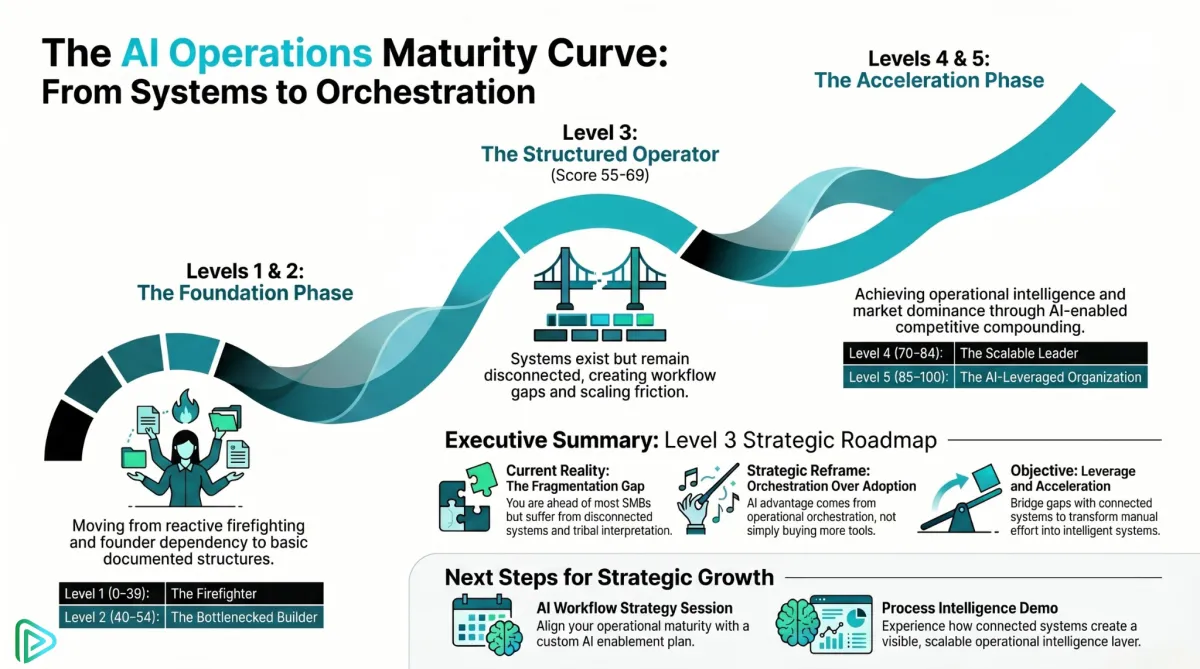
If your business has made it to this stage, you are already ahead of most SMBs. You value structure, you actively use SOPs, and your leadership team thinks operationally. You aren't constantly putting out daily fires—but you are starting to feel a different kind of pain: scaling friction.
At PlaybookOps, we call this Level 3 of the AI Operations Maturity Curve: "The Structured Operator".
For the Structured Operator, the foundation is built, but it is fragmented. SOPs exist but aren't fully integrated into daily workflows, meaning teams still rely on tribal interpretation. Your systems are only partially connected, automation exists only in isolated pockets, and gaining true operational visibility still requires manual effort. As you watch the market evolve, a new strategic concern begins to creep in: "We may have systems… but they aren't capable of supporting AI scale".
The Illusion of More Tools
When you reach this operational risk zone and start worrying that competitors might move faster, the natural temptation is to go on a buying spree. You might think the solution to your scaling friction is simply acquiring more AI tools, standalone automation software, or new reporting dashboards.
However, buying more isolated software will only exacerbate your operational fragmentation. Adding a new AI tool to disconnected systems doesn't create leverage; it just creates another silo.
The Strategic Reframe
To truly accelerate your growth and protect your market position, you must shift your perspective. AI advantage comes from operational orchestration, not tool adoption.
What You Actually Need: Operational Orchestration
You don't need more standalone apps; what you actually need is operational orchestration.
True leverage is achieved when your systems are connected and speaking to one another. By moving beyond basic documentation and transitioning to integrated, intelligent systems, you unlock the operational visibility and acceleration necessary to scale faster than your competitors. Your ultimate goal is no longer just having systems, but having orchestrated systems that allow AI to act as a seamless force multiplier.
Your Next Step
You already know that systems matter. Now, it is time to elevate your operations from fragmented SOPs to true operational intelligence.
Stop buying disconnected tools and start architecting your leverage. Book an AI Workflow Strategy Session or a Process Intelligence Demo with us today to identify your integration gaps and map out your path to operational orchestration.



Mail
Facebook
LinkedIn
X
Pinterest
Reddit