The Execution Gap: Why Your Business Can't Scale Past You — and What the Research Actually Says.
1. The Moment You Knew Something Was Wrong
It was probably a Sunday night.
You were going to step away from work. You had promised yourself, your spouse, your kids. But there was that one thing. The thing only you knew how to handle. The client who only takes calls from you. The proposal that wouldn't go out unless you reviewed it. The fire that would burn unattended unless you walked back to your desk and put it out yourself.
You walked back to your desk.
And somewhere between the third Slack message and the second cup of coffee, the thought arrived - the one you have had a hundred times and tried to bury a hundred more: I built this company so I could have more freedom, and instead I am the bottleneck.
You are not the first founder to have this thought. You will not be the last. And the reason you keep having it is not that you are not working hard enough. It is not that your team is not good enough. It is not that you have not read enough books or hired enough consultants.
The reason you keep having that thought is that the way work flows through your business is architecturally broken - and it has been broken in the same way, for the same reasons, in roughly 99 out of every 100 founder-led businesses that John Warrillow studied for Built to Sell. Only one in a hundred sells. The other ninety-nine stay stuck.
The problem you are describing has a name. It has had a name for over two decades. There is a substantial research literature about it - from Harvard Business Review, McKinsey, Bain, MIT, and Carnegie Mellon. The reason most founders have never heard the name is that the literature was written for Fortune 500 executives, not for the operator-founder running a $5M services company in a second-tier city.
But the problem is exactly the same. And it is the most important problem you will solve this decade.
It is called the execution gap.
2. It Has a Name. It's Called the Execution Gap.
In 2002, Larry Bossidy - the former CEO of Honeywell - co-wrote a book with Ram Charan called Execution: The Discipline of Getting Things Done. It sold over a million copies. It spent 150 weeks on the Wall Street Journal and New York Times bestseller lists. It is the canonical book on this subject.
Bossidy and Charan called the problem "the gap nobody knows." Their argument: companies do not fail because their strategies are wrong. They fail because their organizations cannot deliver on the strategies they have. The gap between what leadership wants and what the organization actually does is where companies die.
Three years later, in July 2005, Michael Mankins and Richard Steele of Marakon Associates published the empirical version of this in Harvard Business Review. They studied companies like Barclays, Cisco, Dow Chemical, 3M, and Roche. Their finding became one of the most cited statistics in modern strategy literature:
Companies on average deliver only 63 percent of the financial performance their strategies promise.
Thirty-seven cents of every dollar in projected strategy value gets lost - not in the strategy itself, but in the execution of it. The Project Management Institute later put a number on it from a different angle: organizations waste roughly $97 million for every $1 billion they invest, due to poor execution.
These are enterprise numbers. They describe what happens to multinational companies with whole departments dedicated to strategy execution. If that is what happens at Cisco, take a moment to imagine what is happening at your $5M company, where the entire execution layer is you, your operations lead, and a part-time consultant.
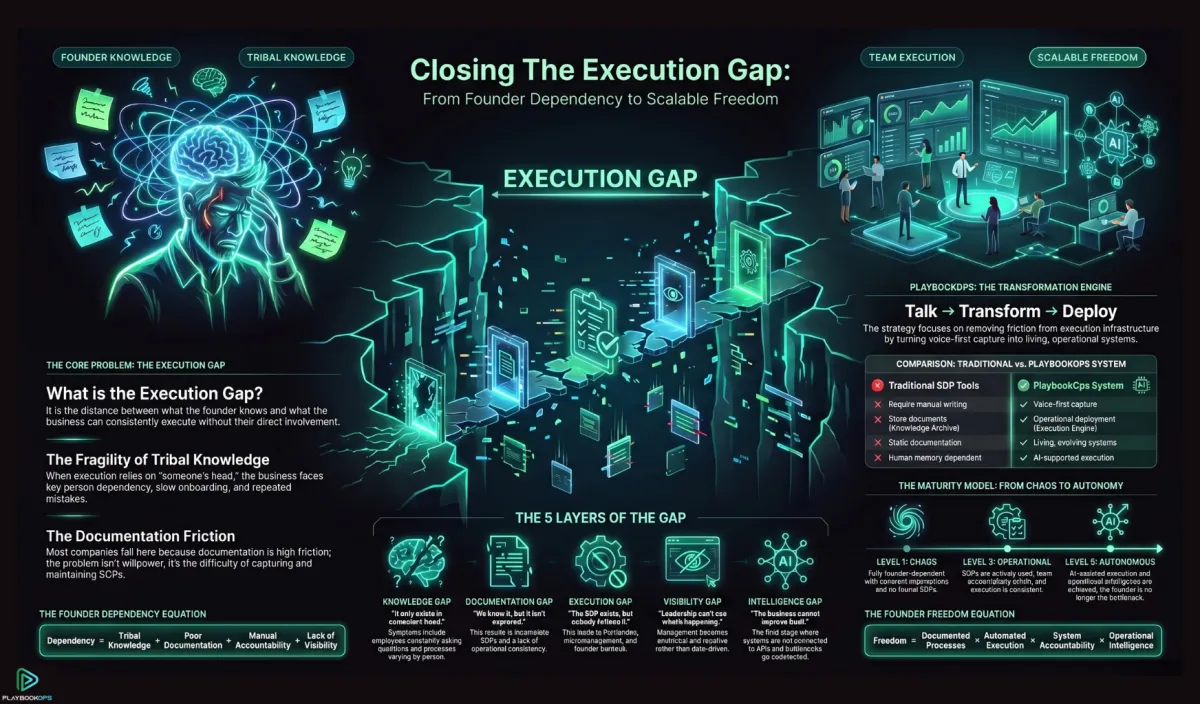
But here is the part the executive literature never quite says out loud. The execution gap is not one gap. It is five, stacked on top of each other, each one creating the conditions for the next. And when you understand them in order, you understand exactly why your business cannot scale past you.
You cannot fix what you cannot name. So let's name them.
3. Layer 1 — What's in Your Head Can't Scale
The Knowledge Gap. The first layer is the one nobody wants to talk about, because the first layer is you.
In 1995, two Japanese researchers - Ikujiro Nonaka and Hirotaka Takeuchi - published a book called The Knowledge-Creating Company. They drew a distinction that has since become the foundation of every serious model of organizational knowledge. There are two kinds of knowledge in any business:
Explicit knowledge — what's written down. SOPs, manuals, databases, training materials. Knowledge that can be transferred.
Tacit knowledge — what's in someone's head. Pattern recognition, judgment, context, the "I just know" that comes from years of doing the work. Knowledge that, in its current form, cannot be transferred.
In most founder-led businesses, the ratio between these two kinds of knowledge is brutally lopsided. The explicit part is whatever fits on a Notion page someone made two years ago and never updated. The tacit part is everything else - and it lives in your head.
This is not a feeling. It is measured.
In 2018, Panopto and YouGov surveyed over 1,000 U.S. knowledge workers in what is still the most comprehensive study of workplace knowledge transfer. Their findings:
42 percent of institutional knowledge is unique to the individual — meaning if the person who holds it leaves, almost half of their job is unrecoverable.
The average knowledge worker wastes 5.3 hours per week either waiting for information from colleagues or recreating institutional knowledge that already exists.
60 percent of employees report it is difficult or nearly impossible to get the information they need to do their job.
These numbers were collected at enterprise scale. In a 20-person founder-led business, the proportions are worse. The founder holds something closer to 70 or 80 percent of the institutional or tacit knowledge. The team works around the founder by triangulating: asking three people, finding the email from 2022, guessing.
And then there is the valuation cost - the one that arrives on the day you try to sell.
John Warrillow, who built his career on studying business exits, found that businesses that depend on the owner typically trade at 3 to 4 times annual profit. Businesses that run themselves - that have documented systems, depth in management, and processes that do not require the founder - trade at 7 to 8 times. McKinsey's Valuation textbook (8th edition, 2025) reaches the same conclusion from the institutional capital side: operational discipline drives premium multiples, not financial engineering.
In concrete terms: a business making $1M a year in EBITDA, dependent on its founder, is worth about $3M. The same business with documented systems is worth about $5M. The $2M difference does not appear on your income statement. It lives entirely in the buyer's head - in their assessment of how much of you they are buying along with the business.
That is the Knowledge Gap. The single biggest valuation depressor in small business is something every founder reading this can see in the mirror.
The literature is clear about what closes it: externalization. Converting tacit knowledge into explicit form. Documentation. But - and this is the trap - the path from "I know I need to document my business" to "my business is actually documented" is a graveyard. Which brings us to Layer 2.
4. Layer 2 — Why Your SOP Folder Is a Graveyard
The Documentation Gap. You have tried this before.
Maybe it was the consultant who came in after the off-site and built a beautiful SOP library in Notion. Maybe it was the operations manager who ran a quarterly initiative to "document everything." Maybe it was you, on a Saturday morning, finally sitting down to write the procedure for how invoicing actually works.
Sixty days later: the documents existed. Nobody used them. The team kept asking you the same questions.
This is not a willpower problem. It is a structural one. According to operational tooling research (Tallyfy, based on observations across hundreds of company implementations), roughly 90 percent of SOP programs fail to drive sustained adoption. The reasons are remarkably consistent across studies:
SOPs are too long, too jargon-heavy, or written by people who don't actually do the work.
They're written once and never touched again. They go stale and lose credibility.
They live separately from the work. The procedure is in one place; the work happens somewhere else.
Adoption is treated as a launch event, not a behavior-change problem.
And above everything else - documentation is high-friction to produce.
That last one is the bug. The people who know how to do the work are the people doing it. Asking them to stop doing it long enough to write it down is asking them to give up the only time they have, in exchange for a deliverable that - based on past experience - probably will not get used anyway.
This is exactly the friction problem that Stanford behavioral scientist BJ Fogg has spent his career documenting. Behavior change happens when the path of least resistance leads where you want to go. Most SOP tools force users to take a high-resistance path: open the doc, format the doc, write the doc, edit the doc, share the doc. By the time they are done, the moment of context is gone.
Meanwhile, the cost of not having documented processes is, per IDC's research, approximately $37,000 per knowledge worker annually in lost productivity. New hires take roughly twice as long to reach full competence when there are no usable SOPs. Manager time gets eaten by repeat questions. Handoffs between people break, because nobody knows what "done" means at the boundary.
There is a real opportunity here that very few founders see clearly: the bottleneck is not motivation, it is friction. Lower the friction enough - and most documentation gets done by accident. But until that shift happens, most companies stall at Layer 2. Forever.
5. Layer 3 — Documented Doesn't Mean Followed
The Execution Gap (the namesake). This is the layer the literature has been arguing about for twenty years. It is the one Bossidy and Charan named. It is the one Mankins and Steele measured at 63 percent. And it is the one that, in a founder-led business, almost always pulls the founder back into the operator seat.
The structure of the problem is this: the SOP exists. It is reasonably well-written. It is accessible. It even has a good owner. And somehow, work still does not get done the way the document says it should.
Three things are happening underneath, and the operational research has named all three:
•Execution variance. The same task gets done differently by different people, producing inconsistent outcomes. Lean and Six Sigma exist as full disciplines because of this problem.
•Handoff failures. Work passes from one role to another without a shared definition of "done." This is the single most common breakage point in cross-functional processes.
•Communication friction. What was intended, what was communicated, what was heard, and what was done are four different things. The Bossidy-Charan framework was essentially built to address this — they identified three core processes (people, strategy, operations) and the failure modes that emerge when any of them breaks.
If you run on EOS, this is the layer where the Traction component shows up. Weekly Level 10 meetings, ninety-day Rocks, scorecards, accountability charts. Wickman's own line is that "vision without traction is hallucination" — which is just the EOS phrasing of the same point Bossidy and Charan made for the Fortune 500. The Process component documents what should happen; the Traction component is the discipline that makes it happen.
But here is the trap most founders fall into at this layer: when the SOP exists and nobody follows it, the easiest solution is for the founder to become the enforcer. To sit in on the meeting. To review the deliverable. To send the reminder. To redo the work that was not done correctly.
Every time you do this, you reinforce the architecture that made you the bottleneck in the first place. You teach your team that the SOP is optional and you are not. You retire from the founder role and re-enroll in the operator role you swore you would leave.
This is where the execution gap stops being an abstract concept from a 2002 book and starts being the reason you cannot take a real vacation.
6. Layer 4 — You Can't Fix What You Can't See
The Visibility Gap. Imagine, for a moment, that the first three layers are solved. Knowledge is captured. Documentation exists and is current. Execution is consistent. Now ask yourself a question:
How do you know?
If you cannot answer that question with data, you have a visibility gap. And the visibility gap is the reason most founders manage emotionally instead of systemically. The questions that fill your week — "did this get done?", "did the client get the proposal?", "is anyone going to follow up on that?" — are visibility questions. They exist because you cannot see the work; you can only see the outcomes after the fact, usually after something has already gone wrong.
In 2026, Gartner formally recognized this problem at the enterprise level by creating an entire new market category — Process Intelligence — replacing what they had previously called Process Mining. The market leader, Celonis, is a unicorn whose entire business is built on a single premise: companies need real-time visibility into how their processes actually flow, not just how the org chart says they should. The category's framing, in Celonis's own language, is that "solving business problems comes down to visibility into how processes and operations actually run."
Enterprise companies have been building this layer for a decade. They have Process Intelligence platforms reading event logs from SAP, Salesforce, Workday, and ServiceNow. They have dashboards that show bottlenecks in real time. They know exactly where work is stuck and why.
You almost certainly do not. And neither does anyone in your peer group. SMBs do not have ERP-driven event logs. They have email, Slack, a CRM, and a project management tool that someone half-configured in 2023. The visibility most large enterprises take for granted is something most SMBs have never even imagined.
But here is the strategically important point: that is a market position, not a permanent state. The same shift that made process intelligence accessible at the enterprise scale is making it newly accessible at the SMB scale. The infrastructure assumption is different — SMBs do not need to mine SAP event logs; they need to make documented processes traceable in the tools they already use — but the destination is the same.
Which brings us to the last and most consequential layer.
7. Layer 5 — Where AI Either Saves You or Destroys You
The Intelligence Gap. In July of 2025, MIT's NANDA initiative published a study that should have ended a lot of arguments. It was based on a review of more than 300 publicly disclosed enterprise AI initiatives, 52 structured interviews with senior leaders, and 153 additional survey responses. The headline finding has by now been cited everywhere:
Despite $30 to $40 billion invested in generative AI, 95 percent of enterprise pilots produce no measurable P&L impact. Only 5 percent generate significant value.
Take a breath with that. Thirty to forty billion dollars. Ninety-five percent failure. This is not noise in the data. This is the system telling us something.
What MIT calls the "learning gap" is what the Execution Gap Framework calls the Intelligence Gap. The researchers found that the failures were not caused by bad models. They were caused by brittle workflows, missing context, and processes that were not structured well enough for the AI to do anything useful with. In one of the more direct quotes from the report: "Most GenAI systems do not retain feedback, adapt to context, or improve over time."
Translated into operator language: companies are trying to put AI on top of operations that are not documented, not standardized, and not observable. And the AI is failing — predictably and reproducibly — for the same reason a new hire would fail in those conditions. You cannot automate what you have not yet captured. You cannot optimize what you cannot see.
Gartner says the same thing from a different angle. In their 2026 forecast: more than 40 percent of agentic AI projects will be cancelled by 2027 due to escalating costs, unclear business value, and inadequate risk controls. At the same time, 60 percent of organizations are planning to deploy AI agents in the next two years, and 40 percent of enterprise applications will have task-specific agents by the end of 2026 (up from less than 5 percent today). The adoption curve is the most aggressive of any emerging technology Gartner currently tracks.
These two facts — that AI adoption is accelerating and that AI projects are failing at unprecedented rates — are the same fact, viewed from different sides. The companies that have documented their processes will deploy AI and pull ahead. The companies that have not will spend money on AI, get nothing back, and fall further behind.
This is the single most consequential operational decision your business will make in the next 24 months. And every layer below it — every one of the four gaps that came before — is the foundation. The Intelligence Gap does not stand alone. It sits on top of Visibility, which sits on top of Execution, which sits on top of Documentation, which sits on top of Knowledge. You cannot leapfrog the stack.
Here is the line that captures the entire argument, and is fully supported by the MIT data:
AI cannot automate what isn't written down.
This is the closing argument. Not a marketing line. A finding.
8. Why This Is Suddenly Urgent
The execution gap has been a known problem in the executive literature for more than twenty years. So it is worth asking: why does it suddenly feel urgent? Why now, and not in 2015, or 2005?
Four things have converged. Individually, each is significant. Together, they create a compounding effect that did not exist before 2024.
First, AI made the cost of execution collapse. Tasks that previously required a junior employee or an outsourced contractor can now be done by an AI at near-zero marginal cost. This means the bottleneck in your business is no longer execution capacity. It is execution clarity. The companies that have captured their processes can deploy AI immediately. The companies that have not are blocked at the starting line.
Second, MIT made the failure visible. Before the NANDA report, the conversation about AI ROI was anecdotal — half hype, half skepticism, no shared evidence base. After it, the 95 percent failure rate is the institutional reference point. Every CFO and every board now needs an answer to the question, "How do we not be in the 95 percent?" Documentation is the answer. It is the most defensible answer in the literature.
Third, agentic AI shifted the technical possibility frontier. Gartner's projection that 40 percent of enterprise applications will include task-specific AI agents by the end of 2026, up from less than 5 percent today, is not an incremental trend. It is a structural shift in what software does. Companies that participate in it will have a categorically different operating model than companies that do not.
Fourth, founder burnout reached a generational peak. The cohort of founders who built businesses through the period from 2020 onward has been operating under conditions — supply chain shocks, remote-work reconfiguration, accelerating customer expectations, labor cost pressure — that have intensified founder-dependency in ways no prior cohort experienced. The EOS network now reaches more than 130,000 companies. Fractional COO services have exploded. Operations-focused content has overtaken growth-focused content on LinkedIn. The demand signal is everywhere, and it is emotional, not just operational. Founders want out of the operator seat.
These four are not parallel trends. They are a single trend, viewed from four angles. The cost of building a documented, observable, AI-leveraged operation has collapsed. The cost of not building one has spiked. The window in which the choice is reversible is closing.
That is what "why now" looks like when the underlying research is doing the work.
9. The Way Out — The Maturity Model
The way the literature has handled progressions like this for decades is through maturity models. The most influential one was developed in the late 1980s at Carnegie Mellon's Software Engineering Institute. It is called the Capability Maturity Model Integration (CMMI), it has five levels, and it is required by many U.S. government contracts because nobody has produced a better framework for process improvement in thirty years.
The CMMI levels, in their original framing: Initial (ad-hoc, individual heroics), Managed (planned and controlled at project level), Defined (documented and standardized), Quantitatively Managed (measured and controlled with data), and Optimizing (continuous improvement). In 2025, the CMMI Institute itself added two new courses on AI maturity, formally extending the framework into the AI era.
The PlaybookOps version of this maturity model is, deliberately, a modernization for SMBs:
•Level 1 — Chaos. Founder runs everything. Tribal knowledge dominates.
•Level 2 — Documented. Core processes are captured. They exist as artifacts.
•Level 3 — Operational. Documented processes are actively used by the team. Accountability exists.
•Level 4 — Intelligent. Operations are observable. Bottlenecks and KPIs are visible in real time.
•Level 5 — Autonomous. AI executes routine work on top of documented, observable processes.
The structure is the same as CMMI's; the destination has been updated. CMMI Level 5 was "Optimizing" — continuous human-driven improvement. The post-2025 destination is autonomous AI-enabled execution. The framework is the same; the destination is new.
Two things matter about this model:
First, the layers are sequential, not parallel. You cannot skip them. AI on top of Chaos is the 95 percent. AI on top of Operational is the 5 percent. The math has been settled.
Second, most SMBs are between Level 1 and Level 2, regardless of how many SOP tools they have purchased. The work of moving from Chaos to Documented is not the work of buying software. It is the work of getting tacit knowledge out of human heads and into a system — at low enough friction that it actually gets done.
10. What This Means for You on Monday Morning
If you take one practical thing from this piece, take this:
Stop trying to optimize what you have not first captured.
Don't buy more software. Don't buy AI tooling. Don't hire another consultant to run another off-site. Don't add a third project management system to the two you are already not using. Those moves all assume your business is at Level 3 or higher. It almost certainly is not.
Instead, start with the layer underneath. Identify the three or four processes in your business that you, personally, are the bottleneck for — the ones that everyone knows have to go through you because nobody else has the context. Capture them. Whatever method gets them out of your head and into a structured form with the least friction, use it. Stop arguing about which SOP tool to use. Just externalize what is in your head.
Then, and only then, will any of the upstream work — execution discipline, operational visibility, AI leverage — produce the results the marketing for those tools has been promising you.
The execution gap has been a known problem in the executive literature for more than two decades. The reason it has finally arrived at your door is that AI has changed the math. The cost of running an operation has collapsed for the companies that have captured their work. It has spiked for the companies that have not.
This is the work in front of you. It is not glamorous. It is not the work that gets a press release. But it is the only work that takes you from operator back to founder — and from there, to whatever it is you were trying to build when you started.
You did not start your business so you could be the bottleneck in it. The research has now caught up to that intuition. So has the technology.
The execution gap is the most important problem you'll solve this decade.
Time to close it.
•••
About the research
The statistics and frameworks cited in this essay are drawn from a substantial body of peer-reviewed and institutional research, including Bossidy and Charan's Execution (2002), Mankins and Steele in Harvard Business Review (July 2005), Nonaka and Takeuchi's The Knowledge-Creating Company (1995), the Panopto Workplace Knowledge and Productivity Report (2018), John Warrillow's Built to Sell (2010), MIT NANDA's The GenAI Divide: State of AI in Business 2025, the Gartner Magic Quadrant for Process Intelligence (2026), and Carnegie Mellon's Capability Maturity Model Integration (CMMI, Version 3.0). A full research brief with citations is available on request.
Ryan Harris is the co-founder and CEO of PlaybookOps, an AI-powered platform that converts voice into structured Standard Operating Procedures for founder-led businesses. He spent 16 years in operations and ran on EOS for 8 years before starting PlaybookOps.



Mail
Facebook
LinkedIn
X
Pinterest
Reddit