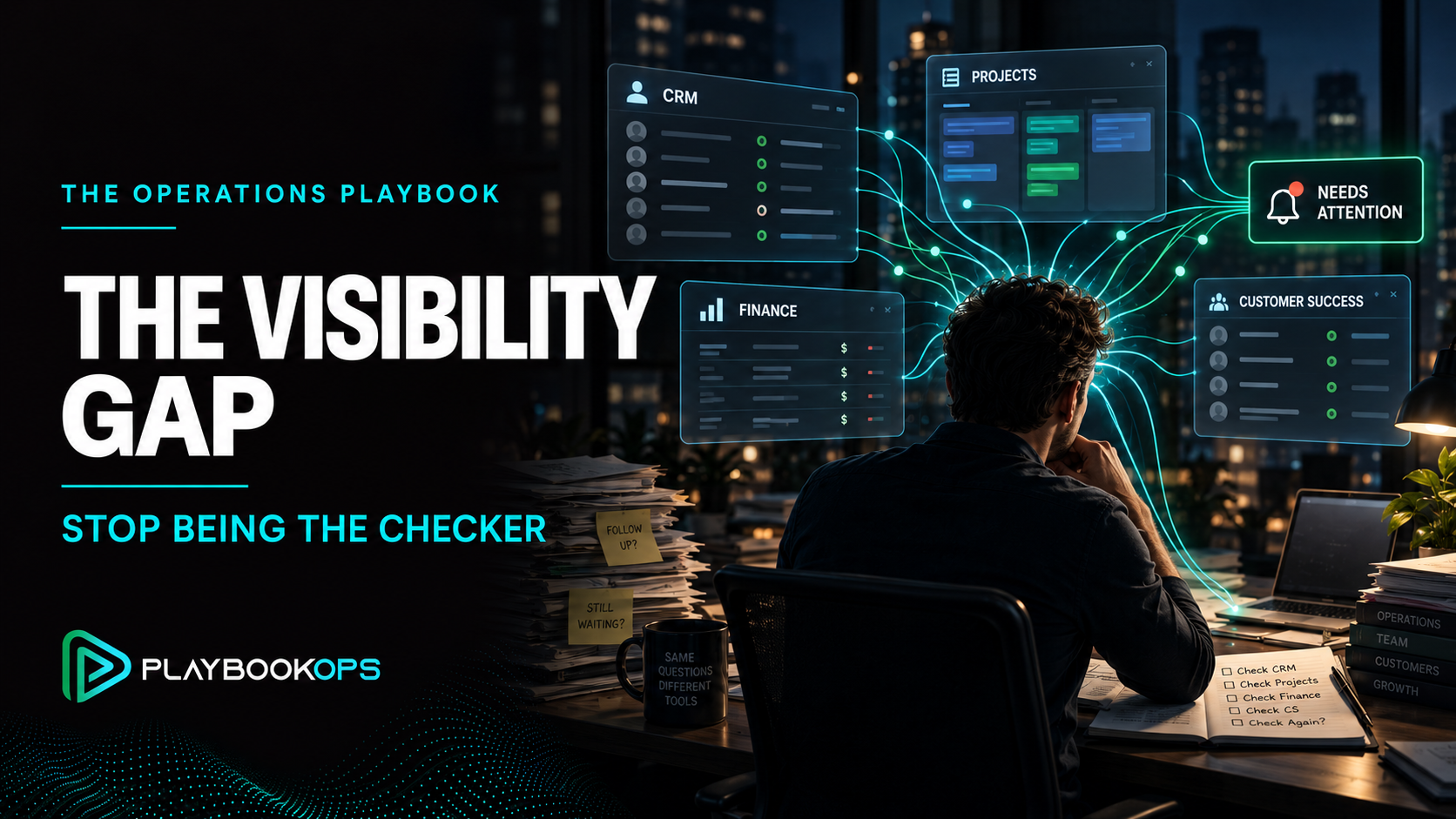
The Execution Gap: Why Your Business Can’t Scale Beyond You
You finally did what everyone told you to do.
You delegated.
You documented the processes.
You gave your team ownership.
You stopped being involved in every task.
And technically, the work is getting done without you.
But something still feels off.
Because even though you're not doing everything anymore...
You're still checking everything.
"Where are we on that project?"
"Did Sales hand that off?"
"Has the client been contacted?"
"Did we send the invoice?"
"Who owns this now?"
"Why is this behind?"
"Did anyone follow up?"
You aren't necessarily fixing the problem anymore.
But you're still the person making sure there isn't a problem.
And that's exhausting in a completely different way.
You escaped being the doer.
But you became the checker.
And that's still founder dependency.
The Next Layer of Founder Dependency
Most founders recognize dependency when they're doing too much of the work.
That's obvious.
You're answering customer questions.
Approving proposals.
Solving employee problems.
Fixing mistakes.
Jumping into projects.
Eventually, you realize something has to change.
So you document.
You delegate.
You standardize.
And the business gets better.
Your team becomes more capable.
Processes become more consistent.
You aren't needed for every decision.
That's real progress.
But then a more subtle form of dependency starts showing up.
You don't need to do the work anymore.
You need to know whether the work is happening.
So you start checking.
You open the CRM.
Then the project management system.
Then Slack.
Then email.
Then you ask someone.
Then you sit through another meeting so everyone can tell you what's happening.
You're no longer carrying all the execution.
You're carrying the visibility of the execution.
That's the next Execution Gap.
I call it the Visibility Gap.
The Visibility Gap
The Visibility Gap appears when work can happen without the founder, but the founder still has to manually reconstruct what's happening across the business.
Sales knows what's happening in Sales.
Operations knows what's happening in Operations.
Finance knows what's happening in Finance.
Customer Success knows what's happening with customers.
But nobody—and often no system—can easily see how all of those pieces connect.
Except you.
You've spent years building the company.
You understand the relationships between the pieces.
You know which client Sales just closed.
You remember the promise that was made.
You know Operations is waiting on something.
You know Finance can't invoice until Delivery finishes.
You know the customer is getting frustrated.
Your team sees their piece.
You see the system.
So even after you've delegated the individual responsibilities, you remain the person mentally connecting them.
And that's why stepping away still feels uncomfortable.
Delegation Without Visibility Creates Anxiety
There's a reason founders keep checking.
It's easy to label it as a control problem.
Sometimes it is.
But often it's something much more practical.
You don't trust what you can't see.
If you can't easily see whether the business is operating correctly, you have two choices.
Trust blindly.
Or check manually.
Most founders choose the second.
Not because they enjoy micromanaging.
Because they have payroll to make.
Customers to retain.
Commitments to fulfill.
Margins to protect.
A business to keep alive.
So they check.
Then they check again.
And eventually checking becomes part of the founder's job.
That's why delegation alone doesn't create Founder Freedom.
You can delegate responsibility and still carry the mental load of making sure everything is happening.
Delegation without visibility doesn't create freedom. It creates anxiety.
This Is Where Operational Intelligence Begins
The Execution Gap is the distance between what leadership knows and what the organization can consistently execute without them.
Early in a company's growth, most of the knowledge lives with the founder.
So the first challenge is getting that knowledge out of their head.
Founder Knowledge → Documented Systems
Then the organization has to turn those documented systems into consistent behavior.
Documented Systems → Team Execution
But something else has to happen after that.
Leadership needs the ability to understand how execution is actually happening.
Not how the SOP says it should happen.
Not what someone remembers from last week's meeting.
Not what five different software platforms individually report.
What's actually happening.
That's the transition from Team Execution to Operational Intelligence.
And it's a major step in operational maturity.
A mature organization doesn't just document how work should happen.
It can see how work is happening.
Most Businesses Have Data. They Don't Have Visibility.
This distinction matters.
Most growing businesses already have plenty of data.
Their CRM has data.
Their accounting platform has data.
Their project management system has data.
Their help desk has data.
Their marketing platform has data.
Their spreadsheets definitely have data.
The problem isn't necessarily a lack of information.
It's that the information exists in pieces.
The founder is often the integration layer.
You look at one system.
Then another.
Then you ask someone what happened.
Then you mentally connect everything.
That's not operational intelligence.
That's human middleware.
And for many founder-led businesses, the founder has unknowingly become exactly that.
The business technically has systems.
But the founder still has to interpret what all those systems mean together.
The Goal Isn't More Dashboards
This is where companies often make another mistake.
They recognize they lack visibility, so they build dashboards.
More reports.
More scorecards.
More meetings.
More notifications.
But more information doesn't automatically create more clarity.
Sometimes it creates the opposite.
Operational Intelligence isn't about seeing everything.
It's about seeing what matters.
Can leadership quickly understand:
Where is work getting stuck?
Who owns the next step?
Where are handoffs failing?
Which processes are consistently breaking?
Where are exceptions occurring?
Where is execution drifting from the standard?
What requires leadership attention?
And equally important:
What doesn't require leadership attention?
That last question is critical.
Founder Freedom doesn't come from knowing everything happening inside the business.
It comes from knowing the business will surface what matters without requiring you to go looking for it.
Your Business Should Tell You When It Needs You
Think about the difference.
In a founder-dependent business, the founder searches for problems.
They check projects.
Review conversations.
Ask for updates.
Attend meetings.
Look through reports.
They are constantly asking:
"Is everything okay?"
In a more operationally mature business, the system surfaces exceptions.
Something falls outside the expected process.
A handoff doesn't happen.
A deadline slips.
A customer metric changes.
A process stalls.
An outcome misses the expected standard.
Now the business tells leadership:
"This needs your attention."
That's fundamentally different.
The founder isn't monitoring the business.
The business is monitoring execution.
And leadership intervenes where judgment is actually required.
That's leverage.
And This Is Why AI Comes Later
This also explains why so many conversations about AI in small businesses start in the wrong place.
Everyone wants AI agents.
Automation.
Predictive analytics.
Intelligent workflows.
But AI needs something to observe.
It needs structured processes.
Defined expectations.
Ownership.
Data.
Execution signals.
Context.
Without those things, AI isn't creating intelligence.
It's processing noise.
The path toward AI-enabled operations doesn't start with AI.
It starts much earlier.
Founder Knowledge
↓
Documented Systems
↓
Team Execution
↓
Operational Intelligence
↓
AI-Enabled Leverage
Each stage creates the foundation for the next.
Skip the foundation and the technology becomes another layer of complexity.
Build the foundation correctly and something much more interesting becomes possible.
AI doesn't just answer:
"What is our process?"
Eventually, it can help answer:
"Where is our execution deviating from the process?"
That's a very different level of operational capability.
The First Move: Stop Asking for Updates
Here's something you can do this week.
Pay attention every time you ask someone for an update.
Don't stop asking yet.
Just write the question down.
"Where is this?"
"Did this happen?"
"Who owns this?"
"Why hasn't this moved?"
"What happened with that customer?"
Then ask yourself:
Why did I have to ask?
Was the information missing?
Was ownership unclear?
Was the handoff invisible?
Was the information trapped in another system?
Was there no defined trigger for escalation?
Was the process happening outside the documented workflow?
Those questions are clues.
They show you exactly where your Visibility Gap lives.
You don't need another dashboard yet.
You need to understand why leadership still has to go searching for answers.
Fix that first.
Founder Freedom Requires More Than Delegation
There's a progression every growing company eventually has to make.
At first, the founder knows everything.
Then the business documents what the founder knows.
Then the team learns to execute it.
Then the organization learns to see its own execution.
And eventually, technology and AI can help interpret, improve, and automate that execution.
That's operational maturity.
And it's how a business slowly stops depending on the founder.
Not because the founder disappears.
But because the organization develops capabilities that used to exist only inside the founder.
Knowledge.
Execution.
Context.
Visibility.
Judgment.
That's the real path toward Founder Freedom.
So if you've delegated the work but still find yourself constantly checking whether everything is getting done, don't assume you need to delegate more.
You may have simply reached the next Execution Gap.
You stopped being the doer.
Now it's time to stop being the checker.
A question worth asking:
What do you still have to manually check every week because your business can't tell you the answer without you asking?