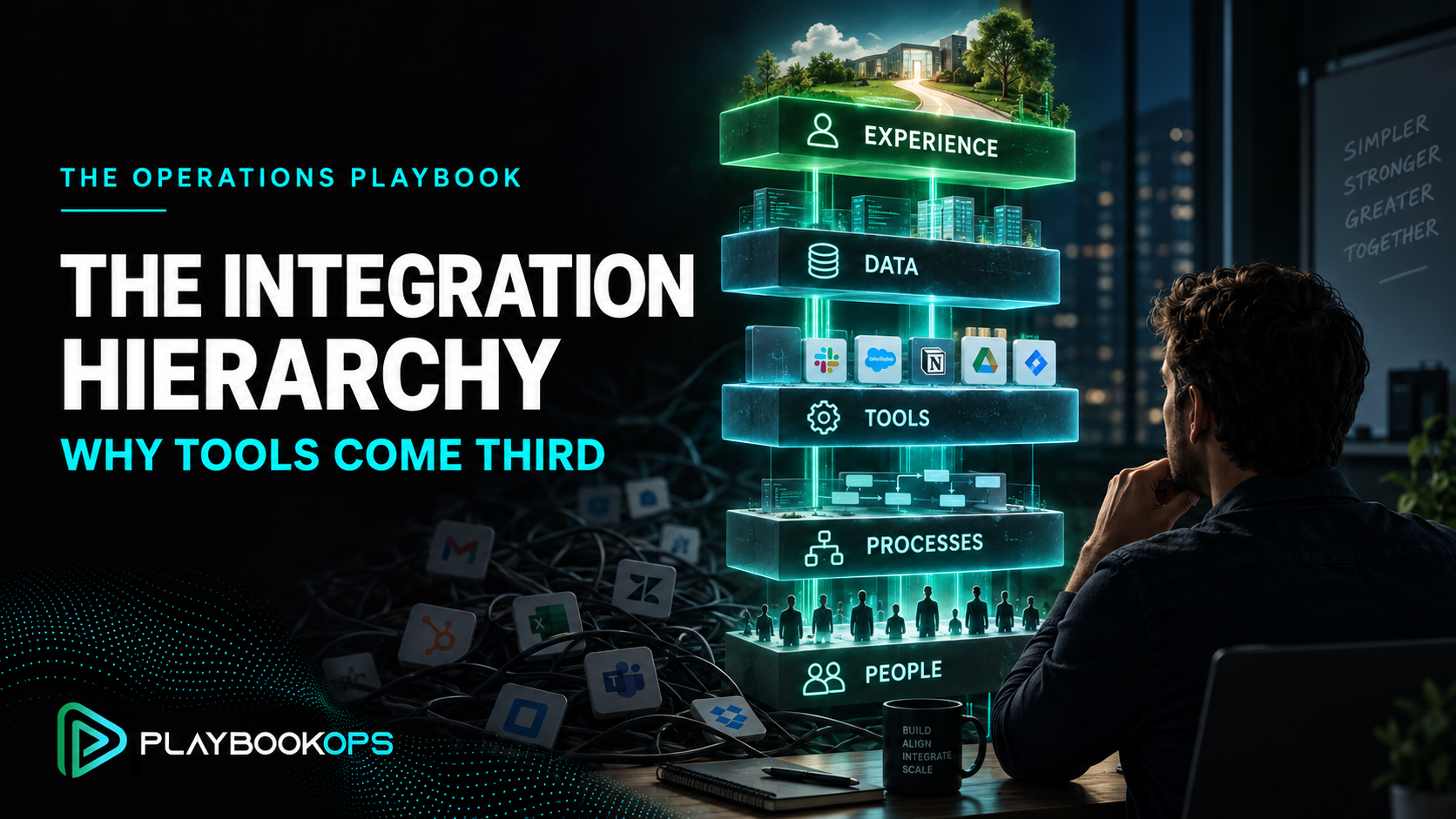
Most businesses integrate in the wrong order.
They start with tools.
A new CRM.
A new project management system.
A new dashboard.
A new automation platform.
A new AI assistant.
And at first, it feels like progress.
There are demos. Workflows. Migration plans. New logins. New dashboards. New possibilities.
But then the old problems come back.
The team still asks where things live.
Handoffs still break.
Data still does not match.
Customers still feel the friction.
And the founder is still the one connecting the dots.
That is the problem.
Integration does not start with software.
It starts with order.
The right order is:
People → Processes → Tools → Data → Experience
That is the Integration Hierarchy.
And if you skip a layer, the business usually routes the confusion back through the founder.
The Cost of Integrating in the Wrong Order
Poor integration creates more work than most founders realize.
It hides inside normal business activity.
Someone copies data from one tool to another.
Someone asks if the CRM is updated.
Someone checks Slack for the real answer.
Someone rebuilds a spreadsheet because the dashboard is wrong.
Someone messages the founder because two systems disagree.
That is not integration.
That is operational debt.
And it gets expensive.
Not always in one dramatic failure.
Usually, it shows up as small daily leaks.
Time leaks.
Context leaks.
Trust leaks.
Customer experience leaks.
Founder energy leaks.
The company may have tools.
But if those tools do not create flow, people have to compensate.
They remember what the system should have remembered.
They chase what the workflow should have triggered.
They clarify what the handoff should have carried.
They report what the dashboard should have shown.
And eventually, the founder becomes the backup operating system.
Again.
Different software.
Same bottleneck.
Why Integration Fails
Integration fails when the foundation is out of order.
Most founders feel a technology problem and assume the solution is a better technology.
Sometimes that is true.
But often, the tool is only exposing a deeper issue.
You cannot connect tools if people are unclear.
You cannot automate processes that are undefined.
You cannot trust data that comes from inconsistent execution.
You cannot create a great customer experience from a disconnected internal system.
That is why the hierarchy matters.
Each layer depends on the one before it.
If the lower layer is weak, the next layer becomes unstable.
Layer 1: People
The first layer of integration is people.
Not software.
Not automation.
People.
Who owns the work?
Who makes the decision?
Who receives the handoff?
Who is accountable when the work gets stuck?
Who has authority to resolve exceptions?
Who needs visibility before the next step begins?
If people are unclear, every system becomes messy.
A project management tool cannot fix unclear ownership.
A CRM cannot fix unclear decision rights.
A dashboard cannot fix a team that does not know who owns the next move.
This is why many integration projects fail before they start.
The company tries to connect tools when it has not aligned people.
The first question is not:
“What software should we use?”
The first question is:
“Who owns this workflow from start to finish?”
Layer 2: Processes
Once people are clear, the next layer is process.
How should the work move?
What starts it?
What completes it?
What does “done” mean?
What happens when there is an exception?
What information must transfer at the handoff?
Where does the process usually break?
Processes define the path.
Without a clear path, tools only make confusion faster.
This is the trap of automation.
A business takes a messy process and builds a workflow around it.
Now the mess moves faster.
Notifications fire.
Tasks appear.
Data syncs.
But nobody trusts the system because the underlying process was never clear.
That is not leverage.
That is automated confusion.
Strong integration requires a clear workflow before a connected tool stack.
Layer 3: Tools
Tools come third.
That is hard for founders because tools are visible.
They feel concrete.
They offer features.
They promise speed.
They make it feel like the business is becoming more sophisticated.
But tools should support the process.
They should not become the process.
The right tool answers practical questions:
Where does the work happen?
Where does the status live?
Where does the handoff happen?
Where does the team go for truth?
Where does leadership see progress?
Where does the customer promise get captured?
Where does the next step trigger?
A good tool reduces friction.
A bad tool adds another place to check.
The goal is not more software.
The goal is less translation.
If your team has to update three systems to prove one thing happened, the tool stack is not integrated.
It is creating administrative drag.
Layer 4: Data
Data comes after tools because data is only as good as the execution behind it.
If the process is inconsistent, the data will be messy.
If the tools are bypassed, the data will be incomplete.
If ownership is unclear, the data will be unreliable.
That is why dashboards often disappoint founders.
The dashboard looks impressive.
But the founder still does not trust it.
So they ask the team what is really happening.
That is the signal.
The dashboard is not yet operational intelligence.
It is just a visual layer sitting on top of weak inputs.
Good data answers questions like:
Where is work stuck?
What is late?
What keeps getting missed?
Which handoffs create the most friction?
Which team is overloaded?
Which customer experience issues repeat?
Which process needs improvement?
Data should reduce guessing.
If it creates more debate, the integration layer underneath is not strong enough yet.
Layer 5: Experience
The final layer is experience.
This is the layer many operators forget.
They think the goal of integration is internal efficiency.
But the real goal is a better experience.
For the team.
For the customer.
For leadership.
For the founder.
A strong integrated system feels different.
The team knows where to go.
The next person has the context they need.
The customer does not have to repeat themselves.
The founder does not have to translate between departments.
Leadership can see what is happening without chasing updates.
Work moves.
Context transfers.
The business feels lighter.
That is the real test of integration.
Not whether the apps are connected.
Not whether the dashboard looks clean.
Not whether the automation runs.
The test is whether the experience improves.
If the team still feels confused, the customer still feels friction, and the founder still has to connect the dots, the business is not integrated yet.
From Tool Stack to Operating System
The shift is simple, but it changes how you build.
Stop thinking of integration as a tech stack project.
Start thinking of integration as an operating system project.
The people know their role.
The process defines the work.
The tools support the workflow.
The data creates visibility.
The experience improves because the business is no longer leaking context.
That is integration.
Not a pile of connected apps.
A connected way of working.
This is where founders start to get freedom back.
Not because they bought more software.
Because the business stops depending on them to translate between disconnected layers.
The founder is no longer the bridge between people, process, tools, data, and customer experience.
The system carries more of that load.
The First Move: Diagnose the Broken Layer
This week, pick one workflow that keeps creating friction.
Do not start by buying a tool.
Walk the workflow through the Integration Hierarchy.
Ask:
Are the people clear?
Is the process clear?
Do the tools support the process?
Can we trust the data?
Does the team or customer feel the friction?
Then find the lowest broken layer.
That matters.
If people are unclear, fix ownership.
If the process is unclear, fix the workflow.
If the tool is wrong, align the system.
If the data is messy, clean the inputs.
If the experience is poor, trace the friction backward.
Integration works when the layers are connected in order.
The Strategic Takeaway
A business does not become integrated because the software is connected.
It becomes integrated when people, processes, tools, data, and experience work as one system.
That is how work starts to flow.
That is how handoffs stop breaking.
That is how visibility becomes real.
That is how the founder stops being the translator.
The goal is not a bigger tech stack.
The goal is a business that can move without you holding the pieces together.
Because if integration still depends on the founder, the business is not integrated.
It is just organized around a bottleneck.
The Question
Where are you trying to fix a tool problem that is actually a people, process, data, or experience problem?
That is where integration begins.